
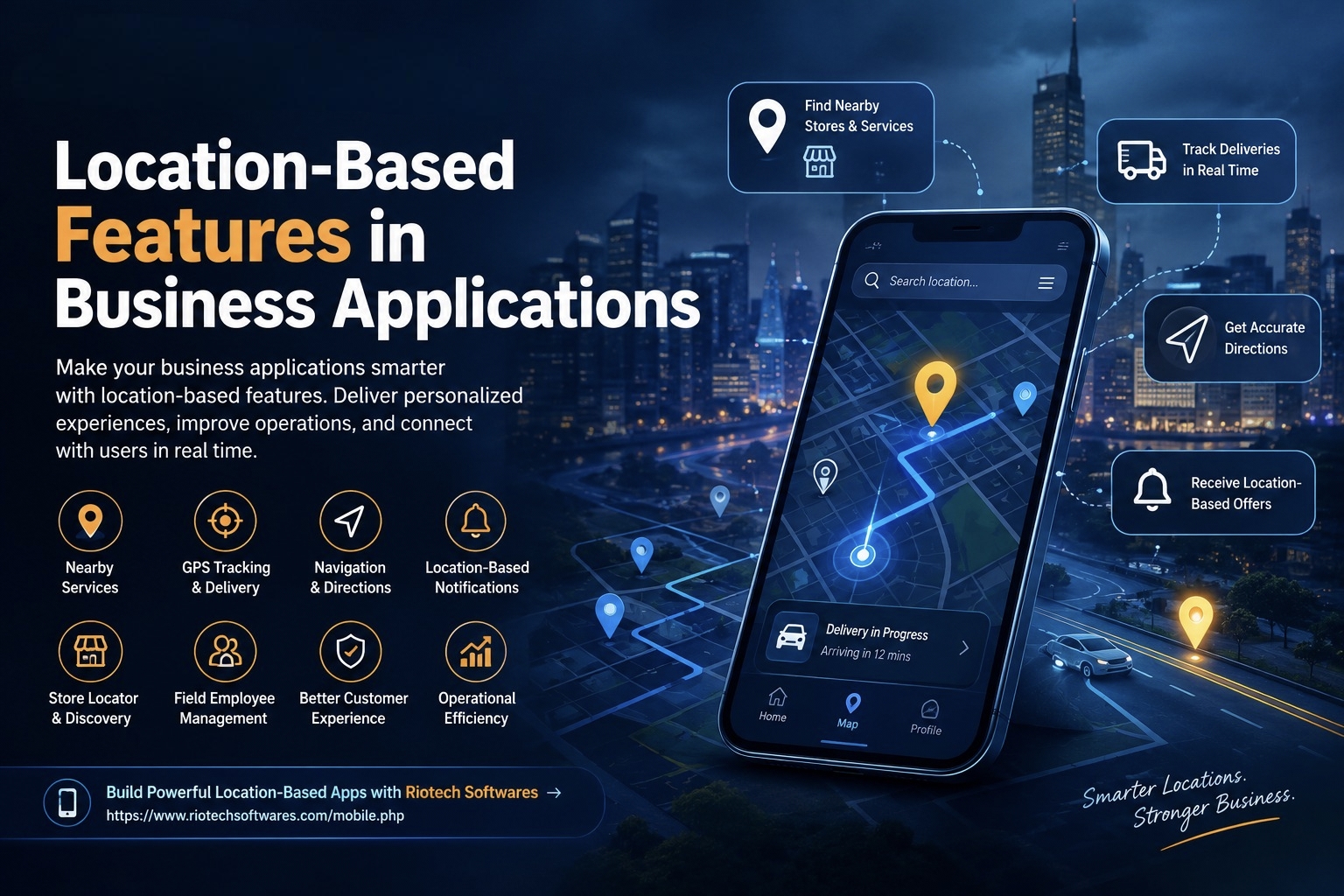
Location-Based Features in Business Applications
Introduction
Mobile applications have become an important part of modern business operations. As businesses look for better ways to engage customers and improve their services, location-based features are becoming increasingly useful in mobile applications.
Location services allow applications to use geographic information to provide features based on a user’s current or selected location. Businesses can use these capabilities for delivery tracking, nearby service discovery, route planning, location-based notifications, field operations, and many other purposes.
When implemented properly, location-based functionality can make a business application more useful while creating a smoother experience for users.
What Are Location-Based Features?
Location-based features are application functionalities that use geographic information to provide relevant services or actions.
Depending on the application, location data can be used to:
- Find nearby stores or services
- Track deliveries and vehicles
- Provide navigation and directions
- Display location-specific information
- Support field employees
- Send location-based notifications
- Improve service availability
- Personalize customer experiences
These features can be integrated into different types of business applications depending on the organization’s requirements.
Why Are Location Services Important for Business Applications?
Customers increasingly expect applications to provide fast and relevant information. Location services can help businesses respond to these expectations by connecting digital services with a user’s physical location.
For example, a food delivery application can use location information to identify delivery addresses and track orders. Similarly, a retail application can help customers find nearby stores or available services.
Businesses can also use location information internally to improve field operations and coordinate employees working across different locations.
Common Location-Based Features
1. Nearby Business and Service Discovery
Applications can help users find stores, offices, service providers, restaurants, or other locations near them.
This can make it easier for customers to discover relevant services without manually searching for locations.
2. GPS-Based Tracking
GPS tracking can be used to monitor deliveries, vehicles, field workers, or service requests.
For businesses that depend on transportation or field operations, tracking features can provide better visibility into ongoing activities.
3. Route and Navigation Features
Location-based applications can provide directions and route information to help users reach a destination.
Businesses can use navigation features for delivery services, appointments, field service applications, and location-based customer experiences.
4. Location-Based Notifications
Businesses can send relevant notifications based on geographic areas or selected locations.
For example, a retail application could notify customers about an offer when they are near a participating store, provided the user has given the required permissions.
5. Delivery and Order Tracking
Location services are particularly useful for applications that involve deliveries.
Customers can view order progress while businesses can monitor delivery operations and improve coordination between customers, delivery personnel, and internal teams.
How Location Features Improve Customer Experience
Location-based functionality can reduce the amount of information customers need to enter manually.
Instead of searching for nearby services or repeatedly entering an address, users may be able to access location-relevant information directly through the application.
This can make mobile applications more convenient and easier to use.
Location Services for Business Operations
Location-based features are not limited to customer-facing applications. Businesses can also use them for internal operations.
For example, organizations with field employees can use location-enabled applications to coordinate service visits, monitor assigned tasks, and improve communication between teams.
Location information can also support scheduling and operational planning when geographic factors are important.
Privacy and Permission Considerations
Location data can be sensitive, so businesses should handle it responsibly. Applications should clearly explain why location information is required and request appropriate user permissions.
Businesses should also collect only the location information necessary for the intended functionality and follow applicable privacy and data protection requirements.
Building Location-Based Mobile Applications
Developing a location-enabled application requires careful planning around user experience, functionality, permissions, data handling, and technical requirements.
Businesses should first identify how location information will provide practical value to users. The location features can then be designed around specific business goals.
Professional mobile app development can help businesses create applications that combine location services with other features such as notifications, maps, user accounts, analytics, and business workflows.
Businesses looking to develop location-enabled applications can explore Riotech Softwares’ Mobile App Development services here: https://www.riotechsoftwares.com/mobile.php.
Choosing the Right Location Features
Not every application needs every location-based feature. Businesses should select functionality based on their customers and operational requirements.
For example:
- Retail businesses may benefit from nearby store discovery.
- Delivery businesses may need GPS tracking.
- Field-service companies may require employee location and route features.
- Travel applications may need navigation and nearby recommendations.
- On-demand services may use location to connect customers with nearby providers.
The right combination of features can make an application more useful without unnecessarily increasing its complexity.
Benefits of Location-Based Business Applications
Well-designed location features can provide several benefits, including:
- Better customer convenience
- Faster access to relevant services
- Improved delivery visibility
- More efficient field operations
- Personalized user experiences
- Better service coordination
- Easier location discovery
- Improved operational insights
Conclusion
Location-based features can add significant value to modern business applications by connecting digital services with real-world locations. From GPS tracking and navigation to nearby service discovery and delivery updates, these features can support both customer engagement and business operations.
However, successful location-based functionality requires thoughtful planning, appropriate permissions, reliable technology, and a clear understanding of business requirements.
With professional mobile application development, businesses can create location-enabled applications that are practical, scalable, and focused on delivering better user experiences. To explore mobile application development solutions, visit https://www.riotechsoftwares.com/mobile.php.
Useful Resources
Businesses can explore mobile application development, location services, GPS integration, application security, and user experience design to understand how location-based technology can support different business requirements.
Visit Website
Learn more about Riotech Softwares Mobile App Development at https://www.riotechsoftwares.com/mobile.php.