
How Cloud Application Development Helps Businesses Scale Faster
Introduction
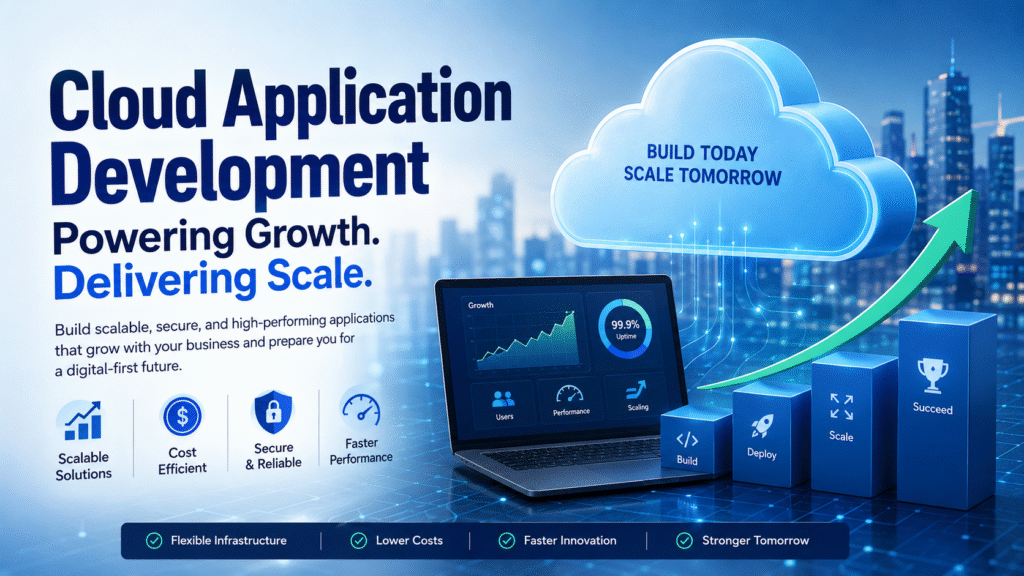
In today’s competitive digital landscape, businesses need technology that can grow with their changing requirements. As customer expectations, online traffic, and digital operations continue to increase, traditional IT infrastructure can make business growth more challenging. This is where cloud application development provides a flexible and scalable solution.
Cloud application development enables businesses to build, deploy, and manage applications using cloud-based infrastructure and services. Instead of relying entirely on physical servers, organizations can use flexible cloud resources to support their applications and adjust infrastructure according to changing business demands.
From startups to large enterprises, cloud application development helps organizations improve scalability, reduce infrastructure limitations, accelerate software deployment, and deliver reliable digital experiences.
In this blog, we explore how cloud application development helps businesses scale faster and why it has become an important part of modern digital transformation strategies.
What Is Cloud Application Development?
Cloud application development is the process of designing, developing, testing, deploying, and maintaining applications that run on cloud infrastructure.
Unlike traditional applications that depend primarily on physical servers, cloud-based applications use cloud computing resources such as virtual servers, cloud storage, databases, networking, and other managed services.
Businesses can develop cloud applications using platforms such as Amazon Web Services (AWS), Microsoft Azure, and Google Cloud.
Depending on business requirements, cloud application development services may include:
- Cloud-native application development
- Cloud migration and application modernization
- API and microservices development
- Serverless application development
- Cloud database integration
- DevOps and CI/CD implementation
- Cloud application maintenance and optimization
By using the right cloud architecture, businesses can build applications that are flexible, scalable, secure, and easier to manage.
Why Do Businesses Need Scalable Applications?
Business growth often means more customers, users, transactions, data, and online activity. If an application cannot handle increasing workloads, it may experience slow performance, downtime, or poor user experiences.
Scalability allows applications to handle changing workloads without significantly affecting performance or availability.
This is one of the biggest advantages of cloud application development. Cloud infrastructure enables businesses to increase or decrease computing resources based on demand.
For example, an e-commerce website may receive a significant increase in traffic during a festive sale. A scalable cloud application can support increased workloads by allocating additional resources when required.
As demand decreases, businesses can reduce resource usage and avoid maintaining unnecessary infrastructure.
This flexibility allows businesses to grow while keeping their digital infrastructure aligned with actual requirements.
How Cloud Application Development Helps Businesses Scale Faster
1. Cloud Application Development Provides On-Demand Scalability
One of the most important benefits of cloud application development is on-demand scalability.
Traditional infrastructure often requires businesses to purchase and maintain additional hardware before growth occurs. Cloud infrastructure provides a more flexible approach by allowing businesses to scale computing resources according to application demand.
Businesses can adjust resources based on:
- Website traffic
- Number of application users
- Data processing requirements
- Seasonal demand
- Business expansion
- Workload fluctuations
This makes cloud application development particularly useful for e-commerce platforms, SaaS products, online education platforms, financial applications, and other digital services.
With scalable cloud infrastructure, businesses can support growth without constantly rebuilding their IT environment.
2. Cloud Application Development Helps Reduce Infrastructure Costs
Building and maintaining physical IT infrastructure can require significant investment in servers, hardware, data centers, maintenance, and upgrades.
Cloud application development offers businesses a more flexible infrastructure model. Organizations can use cloud resources based on their requirements and scale them as their workloads change.
This approach can help businesses manage infrastructure costs more effectively and reduce unnecessary hardware investments.
For startups and small businesses, cloud technology can provide access to powerful computing resources without requiring a large upfront investment in physical infrastructure.
The cost savings can then be redirected toward areas such as:
- Product development
- Marketing
- Customer experience
- Innovation
- Business expansion
3. Cloud Application Development Enables Faster Deployment
In a competitive digital environment, businesses need to launch new products and features quickly.
Cloud application development supports faster software development and deployment through modern technologies such as DevOps, automation, containers, APIs, and CI/CD pipelines.
Development teams can create testing environments, automate deployment processes, and release application updates more efficiently.
As a result, businesses can:
- Launch products faster
- Release new features quickly
- Respond to customer feedback
- Fix application issues efficiently
- Adapt to market changes
Faster deployment helps organizations reduce time-to-market and stay competitive.
4. Cloud Application Development Improves Business Agility
Business requirements can change quickly. Companies may need to introduce new services, expand into new markets, or adjust their digital strategy.
Cloud application development gives businesses the flexibility to respond to these changes.
Cloud resources can be adjusted according to business requirements, allowing organizations to experiment with new ideas and expand their digital capabilities more efficiently.
This improved agility helps businesses respond to market opportunities and changing customer expectations without being limited by traditional infrastructure.
5. Cloud Application Development Supports Global Business Growth
Businesses operating in multiple regions need applications that can provide reliable experiences to customers in different locations.
Cloud infrastructure can help organizations deploy applications across multiple geographic regions and improve accessibility for users worldwide.
With a well-designed cloud application development strategy, businesses can support international expansion and deliver digital services to a broader customer base.
This makes cloud technology particularly valuable for:
- Global e-commerce businesses
- SaaS companies
- Online marketplaces
- Digital education platforms
- International service providers
By using scalable cloud infrastructure, businesses can expand their digital presence while maintaining application performance and availability.
6. Cloud Application Development Enhances Reliability
Application downtime can negatively affect customer satisfaction, revenue, and brand reputation.
Modern cloud application development approaches can incorporate technologies and strategies designed to improve reliability and availability.
Businesses can implement solutions such as:
- Load balancing
- Automated monitoring
- Data backup
- Disaster recovery
- Redundant infrastructure
- Multi-region deployment
These capabilities can help organizations build more resilient applications and reduce the impact of infrastructure failures.
However, achieving high availability requires proper architecture, configuration, monitoring, and ongoing management.
7. Cloud Application Development Supports Better Security
Security is an essential part of modern application development.
Cloud platforms provide various tools and services that can help businesses protect applications and data. Depending on the cloud provider and configuration, organizations can implement security practices such as:
- Data encryption
- Identity and access management
- Network security
- Security monitoring
- Backup and recovery
- Access controls
With proper implementation, cloud application development can help businesses build secure and reliable digital solutions.
However, cloud security follows a shared responsibility model. Businesses must properly configure their cloud environments and implement appropriate security controls.
Cloud-Native Application Development and Scalability
Cloud-native application development is an advanced approach to building applications specifically for cloud environments.
It commonly uses technologies and methodologies such as:
- Microservices
- Containers
- APIs
- Serverless computing
- DevOps
- Continuous integration and deployment
Instead of creating one large application, businesses can develop smaller services that can operate and scale independently.
This approach can provide benefits such as:
- Independent service scaling
- Faster development cycles
- Easier application maintenance
- Flexible deployment
- Better resource utilization
For businesses with complex applications and rapidly changing requirements, cloud-native development can provide a strong foundation for long-term scalability.
Industries Benefiting from Cloud Application Development
E-commerce
E-commerce businesses can use cloud application development to manage high traffic, customer accounts, product catalogs, transactions, and seasonal demand.
Healthcare
Healthcare organizations can use cloud-based applications for digital services, data management, and remote access while following relevant security and compliance requirements.
Financial Services
Banks and fintech companies can leverage cloud technology to support digital banking applications, financial platforms, analytics, and automation.
Education
Educational institutions and e-learning companies can use scalable cloud applications to deliver online courses, learning platforms, and digital resources.
SaaS Businesses
SaaS companies depend on scalable cloud infrastructure to deliver applications to users and support business growth as their customer base expands.
Best Practices for Cloud Application Development
To achieve long-term benefits, businesses should follow a strategic approach to cloud application development.
Choose the Right Cloud Architecture
Select an architecture based on business goals, application requirements, scalability needs, security, and budget.
Prioritize Application Security
Security should be considered throughout the entire development lifecycle rather than added after the application is built.
Use Automation
Automation can improve software testing, deployment, infrastructure management, and monitoring.
Monitor Application Performance
Continuous monitoring helps businesses identify performance issues, optimize resources, and maintain reliable application experiences.
Design for Scalability
Applications should be designed with future growth in mind so they can handle increasing users, traffic, and workloads.
Focus on User Experience
A scalable application should not only handle increased traffic but should also provide a fast, accessible, reliable, and user-friendly experience.
The Future of Cloud Application Development
The future of cloud application development is closely connected with emerging technologies such as artificial intelligence, machine learning, serverless computing, edge computing, and advanced automation.
As businesses continue their digital transformation journeys, the demand for scalable and intelligent cloud solutions is expected to increase.
Organizations that invest in modern cloud application development services can create a stronger technology foundation for innovation and long-term growth.
However, successful cloud adoption requires more than simply moving applications to the cloud. Businesses need the right architecture, technology stack, security strategy, scalability plan, and ongoing optimization.
Conclusion
Cloud application development is helping businesses scale faster by providing flexible infrastructure, on-demand scalability, faster deployment, improved agility, enhanced reliability, and efficient resource management.
Whether it is a startup launching a new digital product or an enterprise modernizing its existing applications, cloud application development provides the flexibility required to support changing business needs.
By investing in scalable cloud solutions and adopting modern cloud-native development practices, businesses can improve their digital capabilities, respond faster to market changes, and deliver better experiences to customers.
As digital competition continues to grow, cloud application development can provide businesses with a flexible, secure, and scalable technology foundation that supports sustainable growth and long-term success.
Frequently Asked Questions
What is Cloud Application Development?
Cloud application development is the process of designing, developing, deploying, and maintaining applications using cloud infrastructure and services.
How does Cloud Application Development help businesses scale?
Cloud application development allows businesses to increase or decrease computing resources based on demand. This helps applications handle growing users, traffic, and workloads more efficiently.
What are the benefits of Cloud Application Development?
The key benefits include scalability, cost efficiency, faster deployment, business agility, global accessibility, improved reliability, and access to modern cloud technologies.
Is Cloud Application Development suitable for small businesses?
Yes. Small businesses can benefit from cloud application development because cloud infrastructure allows them to access flexible computing resources without making large investments in physical servers.
What is Cloud-Native Application Development?
Cloud-native application development is an approach to building applications specifically for cloud environments using technologies such as microservices, containers, APIs, serverless computing, and DevOps.
Why is Cloud Application Development important for digital transformation?
Cloud application development provides businesses with flexible and scalable infrastructure that can support modernization, automation, innovation, and faster digital service delivery.