
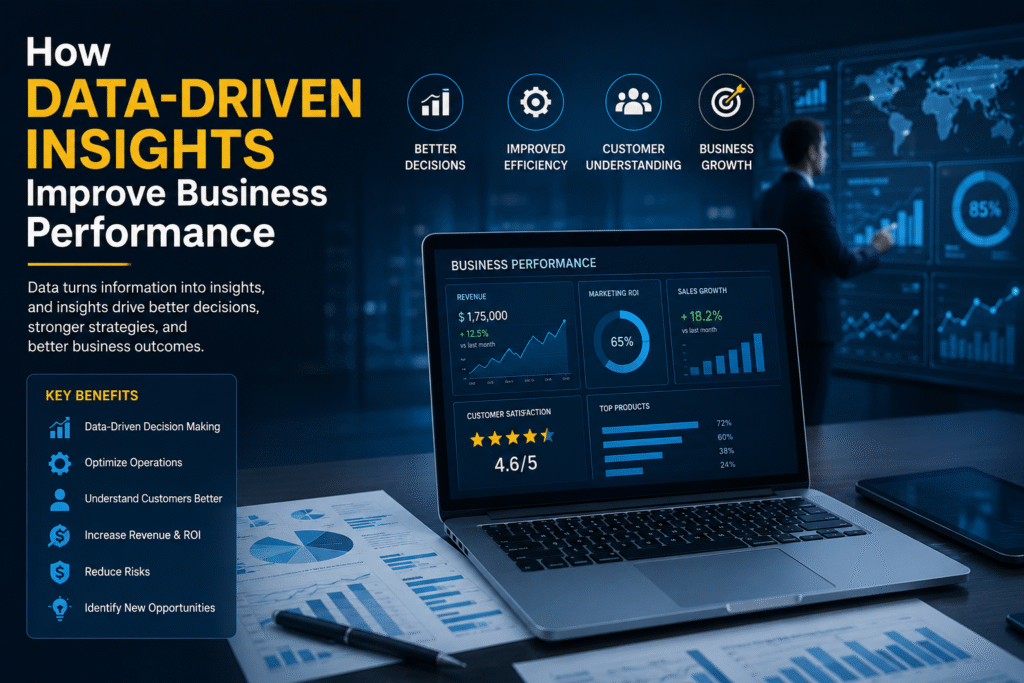
How Data-Driven Insights Improve Business Performance
Introduction
In today’s competitive business environment, making decisions based only on assumptions or intuition is no longer enough. Businesses generate massive amounts of data every day through customer interactions, sales transactions, websites, social media, marketing campaigns, and internal operations. When this data is properly collected and analyzed, it can provide valuable insights that help organizations make better strategic decisions.
Data-driven insights enable businesses to understand what is happening, identify why it is happening, and predict what may happen next. By transforming raw data into actionable information, companies can improve operational efficiency, understand customer needs, reduce costs, identify new opportunities, and achieve sustainable growth.
This is where modern data analytics solutions play an important role. They help organizations turn complex data into meaningful insights that support faster and smarter business decisions.
What Are Data-Driven Insights?
Data-driven insights are meaningful conclusions derived from analyzing business data. Instead of relying solely on assumptions, organizations use facts, trends, patterns, and measurable information to guide their decisions.
For example, an e-commerce company may analyze customer purchase data and discover that a particular product category has higher demand during specific months. Based on this insight, the company can optimize inventory, adjust marketing campaigns, and prepare better sales strategies.
Similarly, a service-based business can analyze customer feedback and support data to identify common complaints. This information can help management improve service quality and increase customer satisfaction.
How Data-Driven Insights Improve Business Performance
1. Enable Better Decision-Making
One of the biggest benefits of data-driven insights is improved decision-making. Business leaders can access accurate and relevant information to evaluate different options before making important decisions.
Instead of asking, “What do we think will work?” businesses can ask, “What does the data tell us?”
Data analytics can help organizations identify trends, measure performance, and compare results. This allows decision-makers to reduce uncertainty and make more informed choices.
2. Improve Operational Efficiency
Data analytics helps businesses identify inefficiencies in their daily operations. By analyzing processes, workflows, resource utilization, and performance metrics, organizations can discover areas where time and resources are being wasted.
For example, data can reveal delays in a supply chain, underperforming processes, or unnecessary operational costs. Once these issues are identified, businesses can take corrective action and streamline their workflows.
Improved efficiency can lead to faster processes, reduced operational expenses, and better overall productivity.
3. Understand Customer Behavior
Customers are at the center of every successful business. Data-driven insights help organizations understand customer preferences, purchasing behavior, interests, and expectations.
By analyzing customer data, businesses can identify:
- Which products customers prefer
- What factors influence purchasing decisions
- Which marketing channels perform best
- When customers are most active
- Why customers leave or stop engaging
These insights allow companies to create more personalized experiences and develop products or services that better match customer needs.
4. Improve Marketing Performance
Marketing teams can use data analytics to measure the effectiveness of their campaigns and optimize their strategies.
For example, businesses can analyze website traffic, conversion rates, customer engagement, campaign performance, and audience behavior. This helps marketers understand which campaigns generate the best results and where improvements are needed.
Data-driven marketing can also help businesses allocate their budgets more effectively by focusing resources on channels and campaigns that deliver measurable results.
5. Support Predictive Business Planning
Data analytics is not only about understanding what happened in the past. Advanced analytics can also help businesses predict future trends.
Predictive analytics uses historical data, statistical techniques, and analytical models to identify potential future outcomes. Businesses can use these insights for:
- Demand forecasting
- Sales predictions
- Customer churn analysis
- Inventory planning
- Risk assessment
- Financial forecasting
By anticipating potential changes, businesses can prepare strategies in advance instead of reacting after a problem occurs.
6. Reduce Business Risks
Every business faces risks related to finances, customers, operations, competition, and market changes. Data-driven insights can help organizations identify potential risks earlier.
By continuously monitoring business metrics and analyzing unusual patterns, companies can detect warning signs before they become major problems.
For example, a sudden decline in sales, an increase in customer complaints, or unusual financial activity may indicate an emerging issue. Early identification allows management to take action before the situation becomes more serious.
7. Identify New Business Opportunities
Data can reveal opportunities that may not be visible through traditional analysis. By examining market trends, customer behavior, and product performance, businesses can discover new areas for growth.
For example, data may show that customers are increasingly interested in a specific service. The business can use this insight to introduce a new offering, target a new customer segment, or expand into a new market.
This makes data analytics an important tool for innovation and long-term business growth.
8. Measure Business Performance More Effectively
Businesses need to know whether their strategies are producing the desired results. Data-driven insights provide measurable performance indicators that help organizations track progress.
Key Performance Indicators (KPIs) can be used to monitor areas such as:
- Revenue growth
- Customer acquisition
- Customer retention
- Sales conversion
- Marketing ROI
- Employee productivity
- Operational costs
By regularly monitoring these metrics, businesses can identify what is working and make timely adjustments when performance falls below expectations.
The Role of Data Analytics Solutions
Managing large amounts of business data manually can be difficult and time-consuming. Modern data analytics solutions help organizations collect, process, visualize, and analyze data more efficiently.
These solutions can provide businesses with:
- Real-time dashboards
- Automated reporting
- Data visualization
- Predictive analytics
- Business intelligence
- Performance monitoring
- Advanced data analysis
With the right analytics infrastructure, decision-makers can access important insights faster and use them to respond to changing business conditions.
Building a Data-Driven Business Culture
Technology alone is not enough to become a data-driven organization. Businesses also need to develop a culture where employees understand the importance of data and use it in their daily decision-making.
Organizations should focus on:
- Data Quality: Ensure that business data is accurate, consistent, and reliable.
- Data Accessibility: Make relevant data available to authorized teams when they need it.
- Data Literacy: Train employees to understand and interpret data effectively.
- Data Security: Protect sensitive business and customer information.
- Clear Objectives: Connect analytics initiatives with measurable business goals.
When technology, people, and processes work together, data can become a valuable strategic asset.
Conclusion
Data-driven insights have become an essential part of modern business strategy. By transforming raw information into actionable knowledge, organizations can make smarter decisions, improve operational efficiency, understand customers, reduce risks, and discover new growth opportunities.
With the support of advanced data analytics solutions, businesses can move beyond traditional decision-making and build strategies based on measurable evidence. As competition continues to increase and markets evolve, organizations that effectively use their data will be better positioned to adapt, innovate, and achieve sustainable business performance.
Ultimately, the goal of data analytics is not simply to collect more data—it is to turn data into meaningful insights and use those insights to make better decisions.