
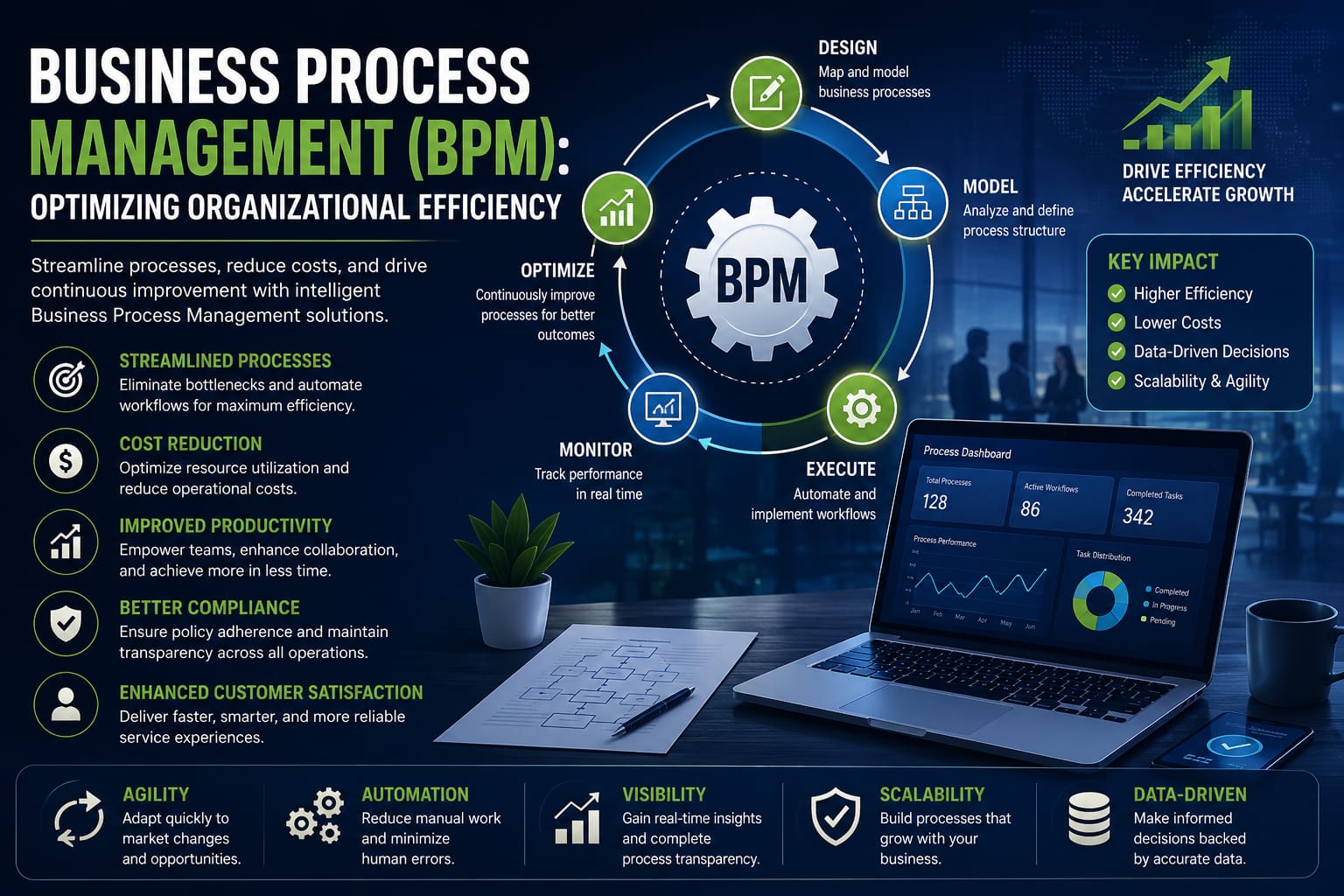
Business Process Management (BPM): Optimizing Organizational Efficiency
Introduction
In today’s competitive business environment, organizations need efficient and well-structured processes to achieve operational excellence. Business Process Management (BPM) is a strategic approach that helps businesses analyze, optimize, and automate workflows to improve productivity, reduce operational costs, and enhance customer satisfaction. By continuously monitoring and refining business processes, organizations can achieve greater efficiency and sustainable growth.
What is Business Process Management (BPM)?
Business Process Management (BPM) is the practice of designing, managing, and optimizing business processes to improve overall organizational performance. It combines people, technology, and business strategies to ensure that workflows are efficient, standardized, and aligned with business goals.
BPM enables organizations to automate repetitive tasks, eliminate bottlenecks, improve collaboration, and make informed decisions based on real-time process insights.
Key Benefits of BPM
- Improves operational efficiency and productivity
- Automates repetitive and manual business processes
- Reduces operational costs and resource wastage
- Enhances process visibility and performance tracking
- Improves collaboration across departments
- Supports faster decision-making with real-time insights
- Enhances customer experience through streamlined workflows
Core Features of Business Process Management
Modern BPM solutions offer several features that help organizations optimize their operations:
- Workflow Automation
- Process Modeling and Design
- Task Management
- Real-Time Monitoring and Reporting
- Document Management
- Business Rules Management
- Integration with ERP and CRM Systems
- Performance Analytics
Industries Using BPM
Business Process Management is widely used across various industries, including:
- Healthcare
- Manufacturing
- Banking and Financial Services
- Retail and E-commerce
- Government Organizations
- Logistics and Supply Chain
- Information Technology
- Human Resources
Best Practices for Successful BPM Implementation
To maximize the benefits of BPM, organizations should:
- Identify and document existing business processes.
- Automate repetitive tasks wherever possible.
- Continuously monitor process performance.
- Integrate BPM with existing business applications.
- Train employees on new workflows and technologies.
- Regularly review and optimize processes for continuous improvement.
Conclusion
Business Process Management (BPM) is a powerful strategy for improving organizational efficiency, reducing operational costs, and enhancing business agility. By automating workflows, optimizing processes, and leveraging real-time insights, organizations can improve productivity, deliver better customer experiences, and stay competitive in today’s rapidly evolving business landscape